 0804581150308045811503
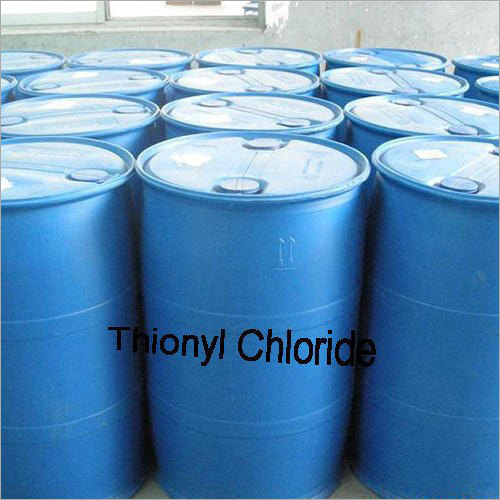
Thionyl Chloride
20.00 - 250.00 INR/Liter
Product Details:
- Refractive Rate 1.515 (at 20 C)
- Form Clear, colorless to pale yellow liquid
- Structural Formula Cl2SO
- Boiling point 74.6 C
- Molecular Weight 118.97 g/mol
- Shape Liquid
- Poisonous No
- Click to View more
X
Thionyl Chloride Price And Quantity
- 20.00 - 250.00 INR/Liter
- 500 Liter
Thionyl Chloride Product Specifications
- Industrial Grade
- Clear, colorless to pale yellow liquid
- Inorganic Chemical
- 1.515 (at 20 C)
- Thionyl Chloride
- Chlorinating agent and dehydrating agent
- No
- Thionyl Chloride
- Other
- Liquid
- 74.6 C
- 118.97 g/mol
- As per company specification
- Cl2SO
- 7719-09-7
- Corrosive, Dangerous Goods
- Sulfinyl chloride
- Reacts with water; not soluble in water
- SOCl2
- 99% min
- Pungent, irritant
- 1.64 Gram per cubic centimeter(g/cm3)
- 104.5 C
- 231-748-8
- 28129090
- Store away from moisture, in tightly closed containers
- 12 months if unopened and stored properly
- Sealed containers, drums
- 1836
- Not applicable (non-flammable, forms flammable gas with water)
- 127 mmHg at 30 C
- Clear, colorless to pale yellow fuming liquid
- Corrosive, causes burns; toxic by inhalation
- Unstable in presence of moisture, decomposes
Thionyl Chloride Trade Information
- Gujarat
- Cash on Delivery (COD), Cash Advance (CA), Cash in Advance (CID), Cheque
- 26000 Liter Per Week
- 3 Days
- Yes
- Contact us for information regarding our sample policy
- 25/50/100 kilo bag available
- Asia, Australia, Central America, North America, South America, Eastern Europe, Western Europe, Middle East, Africa
- , All India, South India, Central India, West India, North India, East India, Gujarat, Karnataka, Kerala, Lakshadweep, Mizoram, Meghalaya, Manipur, Andhra Pradesh, Bihar, Chandigarh, Daman and Diu, Goa, Jharkhand, Odisha, Punjab, Assam, Delhi, Dadra and Nagar Haveli, Andaman and Nicobar Islands, Arunachal Pradesh, Chhattisgarh, Haryana, Himachal Pradesh, Jammu and Kashmir, Madhya Pradesh, Maharashtra, Nagaland, Rajasthan, Sikkim, Tamil Nadu, Telangana, Tripura, Pondicherry, Uttar Pradesh, Uttarakhand, West Bengal
- iso and msme certified company
Product Description
Product details
|
Molar Mass |
118.97 g/mol |
|
Usage/Application |
Industrial |
|
Packaging Type |
Drum |
|
Packaging Size |
50, 100 and 220 Kg |
|
Chemical Formula |
SOCl2 |
|
Density |
1.64 g/cm3 |
|
Boiling Point |
74.6 Degree C |
Properties and Safety Precautions
Thionyl chloride is classified as a dangerous and corrosive chemical that decomposes in the presence of moisture, releasing toxic gases. It exhibits high vapor pressure and a low melting point, while being non-flammable but forming flammable gases with water. Always use proper protective equipment and store it in tightly closed containers to maintain stability.
Versatile Industrial Applications
Leveraged primarily as a chlorinating and dehydrating agent, thionyl chloride is vital in the manufacture of pharmaceuticals, dyes, agrochemicals, and various organic syntheses. Its ability to transform key molecules makes it indispensable in chemical processes across multiple industries.
FAQs of Thionyl Chloride:
Q: How should thionyl chloride be stored to maintain its stability?
A: Thionyl chloride should be stored in sealed containers or drums, away from moisture and humidity, to prevent decomposition. A cool, dry, and well-ventilated area is essential for preserving its shelf life and purity.Q: What precautions are necessary when handling thionyl chloride?
A: Due to its corrosive nature and toxicity by inhalation, always wear appropriate protective gear, such as gloves, goggles, and respiratory equipment. Additionally, handle thionyl chloride in a fume hood or well-ventilated environment to avoid exposure.Q: When is thionyl chloride commonly used in industry processes?
A: Thionyl chloride is commonly employed during chlorination and dehydration reactions in the synthesis of pharmaceuticals, dye intermediates, agrochemicals, and organic compounds. Its usage is critical in steps that require the removal or introduction of chlorine-containing groups.Q: Where does thionyl chloride find its main applications?
A: Its primary applications are seen in chemical, pharmaceutical, dye, and agrochemical industries. It is typically used in production facilities that perform organic synthesis and require chlorinating or dehydrating agents.Q: What benefits does thionyl chloride offer in organic synthesis?
A: Thionyl chloride provides efficient and selective chlorination and dehydration, facilitating the conversion of alcohols to chlorides or other functional groups. This improves process yields and is integral to the synthesis of key intermediates.Q: Which process should be followed for disposal of unused thionyl chloride?
A: Unused thionyl chloride must be disposed of in accordance with local hazardous waste regulations, ideally using chemical neutralization methods by trained professionals in approved facilities, as it reacts violently with water and poses significant risks.Q: Is thionyl chloride soluble in water?
A: Thionyl chloride is not soluble in water and reacts dangerously upon contact, releasing toxic and flammable gases. Therefore, direct mixing with water must be strictly avoided.Tell us about your requirement

Price:
Quantity
Select Unit
- 50
- 100
- 200
- 250
- 500
- 1000+
Additional detail
Mobile number
Email

Other Products in 'Liquid Chemical' category



We are only dealing in Bulk Orders
Contact

- 2981, Nr. Gurjari Mata Vad, Eye Hospital Road, Anand,Anand - 388320, Gujarat, India
- Phone : 08045811503
- Send Inquiry
TREASURE CHEM GUARD LLP
GST : 24AAWFT0315R1ZK
GST : 24AAWFT0315R1ZK
 Send Inquiry
- Mr Virendra Patel (Partner)
- Mobile :08045811503

TREASURE CHEM GUARD LLP
All Rights Reserved.(Terms of Use)
Developed and Managed by Infocom Network Private Limited.
Developed and Managed by Infocom Network Private Limited.

